Why Predictable Pricing needs to be solved before we see more widescale adoption of AI in Education
Before I started working with education orgs on AI adoption, I assumed guardrails would be the hardest problem to solve. I was wrong.
The real blocker turns out is predictable pricing.
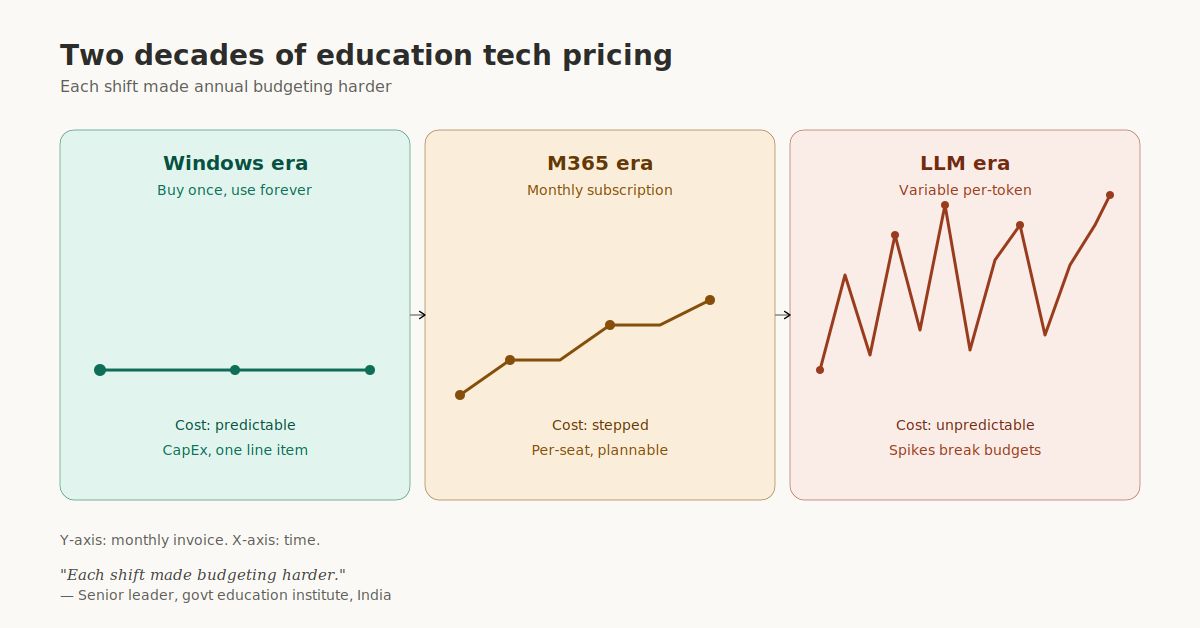
A senior leader at a government institute in India put it best:
In two decades of education tech adoption, we went from buy-once-use-forever (Windows), to monthly subscription (M365), to monthly variable cost based on usage (OpenAI). Each shift made budgeting harder.
Education orgs run on planned annual budgets. Per-token pricing that varies by model is a fundamentally different beast. You can cap per-user. You can cap globally. But that's rationing, not predictability.
What We've Tried
Here's what we've tried across projects like Sakshm and CT Nova:
→ Restrict: per-user budgets enforced at login. Works, but feels like rationing learning.
→ Reduce: default to lower models i.e. Sonnet or Haiku instead of Opus. Big cost drop, quality holds for most everyday use cases.
→ Reuse: caching for predictable spikes. When a teacher posts an assignment and 40 students click "explain the question," caching pays for itself fast.
None guarantee a predictable monthly invoice.
The Self-Hosted Tradeoff
The last resort is deploying models inside the org's own tenant. Works, but the total cost climbs and most institutions can't justify it.
The Open Problem
Affordable access to quality models with predictable pricing is still an open problem.