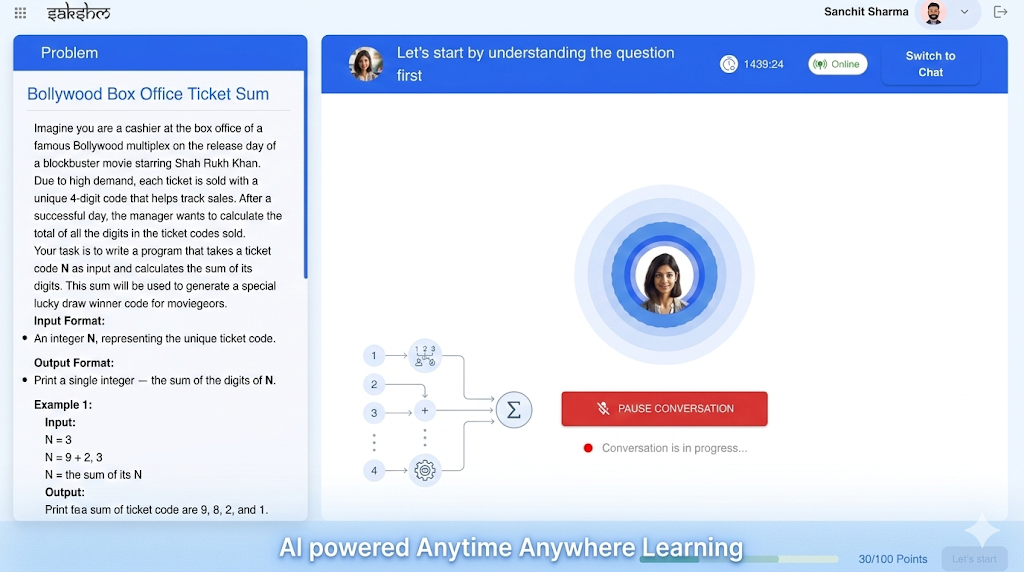
Socratic AI Tutor for Coding
An AI-powered coding tutor that uses Socratic questioning to strengthen reasoning, not replace it
Hypothesis
As coding becomes easier with AI assistance, the real risk for students is not lack of access—but loss of reasoning. If learners offload thinking to AI too early, they fail to build durable problem-solving skills. An AI tutor designed with Socratic principles can guide students through reasoning without giving away solutions, preserving cognitive effort while accelerating learning.
Solution
Why this problem: Students are increasingly using AI tools while learning to code, but most systems optimize for speed and correctness, not understanding. This leads to shallow learning, brittle knowledge, and poor transfer to exams, interviews, and real-world problem solving.
- Why Socratic tutoring: The Socratic method forces articulation of thought, hypothesis testing, and reflection. When embedded into AI, it enables guidance without solution leakage.
- Why structured coding practice: From fundamentals to advanced data structures and algorithms, students need deliberate practice with feedback—not just answers.
- Why AI (with constraints): AI can scale 1:1 tutoring, but must be explicitly designed to withhold solutions and instead probe reasoning.
- Design principle: “Help me think, not tell me the answer.”
Product
- Socratic AI Coding Tutor: Conversational tutor that asks guided questions instead of revealing solutions
- Progressive coding curriculum: Basics → intermediate programming → advanced DSA & algorithms
- Reasoning-first interaction: Validates approach, assumptions, and edge cases before allowing progress
- No direct answers: Tutor refuses to name algorithms or provide final code
- Stepwise scaffolding: Hints escalate only when the learner is genuinely stuck
- Practice environment: Students write, test, and iterate code while explaining their logic
- Reflection loop: Explain → Attempt → Debug → Reflect → Retry
- Assessment layer: Evaluates completeness, correctness, and efficiency of reasoning
Demos
-
Socratic Tutor for Contextual Coding: A walkthrough of the Socratic tutor in action—guiding students through coding problems with contextual hints instead of answers.
👉 Watch Demo -
Voice AI for Algorithm Discussion: A demo of voice-based AI interaction where students discuss coding algorithms before writing code—simulating an interview-style reasoning session.
👉 Watch Demo
Research & Validation
This work is formally documented and evaluated in a peer-reviewed ACM publication:
Paper: Socratic AI Tutor for Programming Education
Venue: ACM
Link: https://dl.acm.org/doi/epdf/10.1145/3788679
The paper details:
- Tutor design principles and guardrails
- Socratic prompting strategies
- Evaluation of learning outcomes
- Evidence that reasoning quality improves without solution dependency
Results
Quantitative
- Improved problem-solving depth compared to answer-revealing AI tools
- Higher retention of algorithmic concepts across sessions
- Better transfer to unseen coding problems
- Reduced “copy-paste” behavior and premature solution fixation
Qualitative
- Students reported feeling “guided, not spoon-fed”
- Increased confidence in tackling new problems independently
- Clear distinction between learning with AI vs delegating to AI
- Strong applicability for competitive programming, interviews, and CS fundamentals
Takeaway
AI does not have to replace thinking to be useful. When designed with Socratic constraints, AI can become a force multiplier for reasoning—helping students learn how to think, not just what to write.