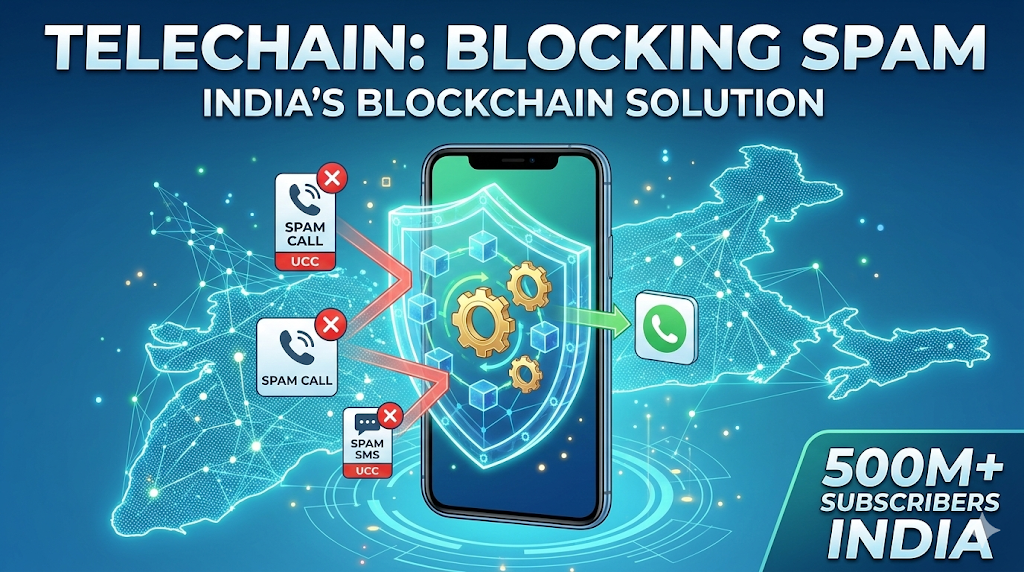
Prevent Tele-Spam using Blockchain
Blockchain-based solution to regulate and prevent spam calls and SMS at scale for ~500M mobile subscribers in India
Overview
Unsolicited Commercial Communications (UCC) are communications—voice calls or SMS—made to subscribers without their consent or willingness. Apart from being a source of inconvenience, such communications impinge on the privacy of individuals. Despite several regulatory measures taken to curb the menace of spam, it continued to be a nuisance to subscribers while posing challenges to telecom operators and regulators alike. The existing ecosystem comprised several entities, and earlier mechanisms for detecting, preventing, and auditing UCC had significant gaps.
Blockchain offers a revolutionary solution to fundamentally improve the regulation and delivery of commercial communications. It allows all players in the ecosystem to share customer information and transaction histories securely over a distributed data infrastructure, with the consent of the user and without compromising on the customer's privacy or sensitive business information.
Motivation
India's telecom ecosystem serves hundreds of millions of subscribers, and spam calls/SMS were a massive, largely unregulated problem. Existing complaint-driven enforcement was reactive and ineffective—all previous approaches to the problem of UCC were ex-post. A system-level solution was needed that could provide end-to-end transparency, enforce consent at scale, and bring accountability to every entity in the commercial communications delivery chain.
Approach
We presented a consortium blockchain-based architecture to address the UCC problem in India. Unlike all previous approaches which were ex-post, our approach to regulatory adherence is ex-ante—preventing violations before they occur rather than punishing them after the fact.
The solution improves subscriber experiences and the efficiency of regulatory processes while positively impacting all stakeholders in the telecom ecosystem. Key design elements include:
- Preference registry on blockchain: Enables fine-grained subscriber consent and preference control, shared securely across all ecosystem participants
- Consent registration & acquisition: Transparent, auditable consent flows between content providers, telemarketers, and subscribers
- Scrubbing and compliance: Real-time verification of consent before commercial communications are delivered
- Scalability: Designed and validated for ~500M mobile subscribers in India
As part of the project, we created several proof-of-concepts to demonstrate how DLT could address the problem at national scale. The work contributed directly to TRAI's regulatory framework.
Technical Architecture
Telechain is built as a permissioned consortium blockchain deployed on Microsoft Azure, connecting all entities in the UCC ecosystem onto a shared, auditable ledger.
Ecosystem Entities
- Subscribers: ~500M mobile users whose preferences and consent must be honored
- Access Providers: Telecom operators (e.g., Airtel, Vodafone Idea, Jio) responsible for delivering communications
- Telemarketers: Registered entities that send commercial communications on behalf of content providers
- Content Providers / Principal Entities: Businesses originating commercial communication campaigns
- Regulator (TRAI): Oversight, audit, and enforcement
On-Chain Transactions & Events
The blockchain records the full lifecycle of commercial communication regulation:
- Entity Registration: Onboarding of telemarketers, content providers, and access providers onto the distributed ledger with verified identities
- Preference Registration: Subscriber preferences (category-level opt-in/opt-out, time-of-day restrictions) recorded on-chain, enabling fine-grained control far beyond the binary block/allow of the earlier NCPR system
- Consent Acquisition: Digitally signed, timestamped consent tokens between subscribers and content providers — creating an immutable, auditable trail
- Consent Revocation: Subscribers can revoke consent at any time; revocation is propagated across the network in real-time
- Scrubbing: Before any commercial communication is sent, the message is "scrubbed" against the on-chain preference registry and consent records — this is the core ex-ante enforcement mechanism
- Complaint Registration & Resolution: Complaints are logged on-chain with full provenance, enabling the regulator to trace back the entire chain of responsibility
- Audit Events: All state transitions are recorded as immutable events, providing regulators full visibility into compliance across the ecosystem
Smart Contract Design
- Registration contracts: Govern entity lifecycle (register, suspend, deactivate) with role-based access
- Preference contracts: Manage subscriber preference state with support for category-level, sender-level, and time-based rules
- Consent contracts: Handle consent grant/revoke flows with cryptographic verification
- Scrubbing contracts: Enforce pre-delivery compliance checks against preference and consent state
- Complaint contracts: Manage complaint lifecycle from filing through resolution and penalty
Scale
The system was designed and validated for India's telecom scale:
- ~500M mobile subscribers whose preferences must be maintained and queried in real-time
- 230M+ subscribers already registered in the National Customer Preference Register (NCPR) at the time of deployment
- Billions of commercial SMS per day requiring real-time scrubbing against the on-chain preference and consent registry
- Multiple telecom operators (all major Indian access providers) participating as consortium nodes
- Country-wide deployment: The regulation mandating DLT was implemented nationally across all Indian telecom operators, making it one of the largest blockchain deployments in the world for a regulatory use case
Impact
The proposal described in this work was a primary contributor to the revision of TRAI regulations concerning UCC and spam. The new regulations published in July 2018 were first of a kind in the world, amending the 2010 Telecom Commercial Communication Customer Preference Regulation (TCCCPR) by mandating the use of blockchain/distributed ledgers in addressing the UCC problem.
The paper provides a holistic account of the project's evolution from (1) design and strategy, to (2) regulatory and policy action, (3) country-wide implementation and deployment, and (4) evaluation and impact.
Recognition
- TRAI Regulation: Primary contributor to the Telecom Commercial Communications Customer Preference Regulations, 2018 — first regulation in the world to mandate blockchain for telecom compliance
- TRAI Acknowledgement: Letter from TRAI acknowledging effort towards formulating long-term blockchain strategy for telecom services (PDF)
- Microsoft Research Project Page: Telechain
Collaborators
Partners
Press Coverage
Tech Mahindra and Microsoft Enable a Robust Blockchain-Based Ecosystem to Fight Spam Calls in India
Tech Mahindra, Microsoft join hands to curb pesky calls
Tech Mahindra, Microsoft to develop blockchain-based solution to curb spam calls
Tech Mahindra, Microsoft join hands to develop blockchain-based technology to curb pesky calls and SMS
Tech Mahindra, Microsoft bank on blockchain to put an end to pesky calls
Indian telcos reviewing blockchain-based solutions to curb pesky calls
Publications
- Telechain: Bridging Telecom Policy and Blockchain Practice
ACM COMPASS 2022
- Telecom Commercial Communications Customer Preference Regulations, 2018
TRAI Official Regulation