Prayana: Technology for Financial Inclusion
Supporting financial management in low-resource settings through ethnographic research and mobile technology interventions for financially vulnerable populations
Overview
This project was done in collaboration with several microfinance institutions (MFIs) and NGOs in the space of financial inclusion. We conducted detailed ethnographic studies to understand the prevalent problems in micro-finance and formal banking—and how hundreds of millions of people still do not have access to formal credit. We worked closely with several organizations to uncover the problems leaving millions of people marginalized from the formal banking sector and came up with technology interventions to support financial management by empowering intermediaries.
Motivation
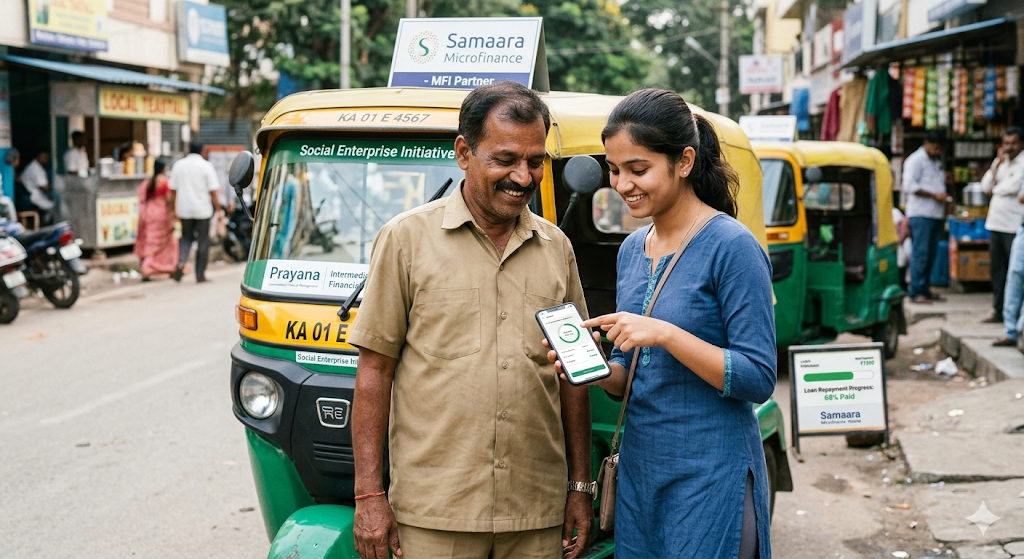
In India, a vast population remains excluded from formal financial services. Loan management for financially vulnerable populations—such as auto-rickshaw drivers—is a daily struggle. Loan payment is a collaborative achievement between collectors and drivers, yet both have limited resources at hand for managing the process. Existing systems failed to account for the realities of low print literacy, limited technical literacy, and the deeply social nature of financial management in these communities.
Prayana
We designed Prayana, a novel mobile phone-based application for intermediated loan management in a resource-constrained setting. The design was informed by an ethnographic study of a social enterprise that manages auto-rickshaw loans for drivers, taking charge of collections.
Prayana shares the principles of many behavioral change technologies—education, motivation, nudges—but is designed for users with a range of print, technical, and financial literacies. It embodies the core design sensibility of enhancing users' agency. Rather than putting the onus solely on drivers to better manage their money, Prayana enhances the collaborative work of loan management, supporting both drivers and collectors.
Key Design Principles
- Intermediated design: Built for both collectors and drivers, reflecting the collaborative nature of loan management
- Agency enhancement: Empowers users rather than prescribing behavior
- Mixed literacy support: Designed for users with varying levels of print, technical, and financial literacy
- Behavioral nudges: Incorporates education, motivation, and gentle nudges adapted for the target population
Expanding Scope
We later expanded the scope of the work to include:
- Community-centric application: A first-of-its-kind community app for drivers, enabling peer support and information sharing
- Data-driven backend: A backend system supporting data-driven decision making for the social enterprise managing loans
Research Contributions
The project produced a rich body of research across multiple top-tier venues:
- Ethnographic foundations: Deep qualitative studies of loan management practices, monetary ecologies, and the collaborative work of loan payment in cash economies
- Design for inclusion: Novel approaches to designing financial management tools for users with mixed literacies
- Impact analysis: Study of intended and unintended consequences of introducing digital financial management tools in low-resource settings
- Scaling: Partnership with Three Wheels United to scale the technology intervention
Collaborators
Partners
Press Coverage
Publications
- Prayana: A Journey Towards Financial Inclusion
ICTD 2017
- Prayana: Intermediated Financial Management in Resource-Constrained Settings
CHI 2018
- Designing a Financial Management Smartphone App for Users with Mixed Literacies
ICTD 2019
- Digitizing Monetary Ecologies: Intended and Unintended Consequences of Introducing a Financial Management App in a Low-Resource Setting
CSCW 2019
- Working Digital Money into a Cash Economy: The Collaborative Work of Loan Payment
CSCW Journal 2017