Healthcare Interoperability & Data Exchange
Building interoperability solutions and mobile applications for public healthcare data exchange, integrating hospital information systems across India
Overview
Advances in technology have made digital collection of health-related information easy, but data still largely remains siloed within the boundaries of various applications. Data exchange plays an important role in public healthcare — having timely access to the right data can allow detection of the spread of a disease, assess effectiveness of government schemes, and inform policy decisions. While data eventually reaches researchers and scientists for analysis, the delay (usually months) hampers timely actions. COVID-19 exposed glaring loopholes in global health infrastructure, one of the major ones being the lack of information exchange between health entities in a timely manner.
This project encompassed work across three areas: interoperability research, mobile applications for data exchange, and a study of hospital management systems to identify gaps in existing workflows.
Key Focus Areas
- Information exchange between hospitals and central authorities
- Information exchange between central authorities
- Mobile applications for field data capture and exchange
Pub/Sub Architecture for Healthcare Data Exchange
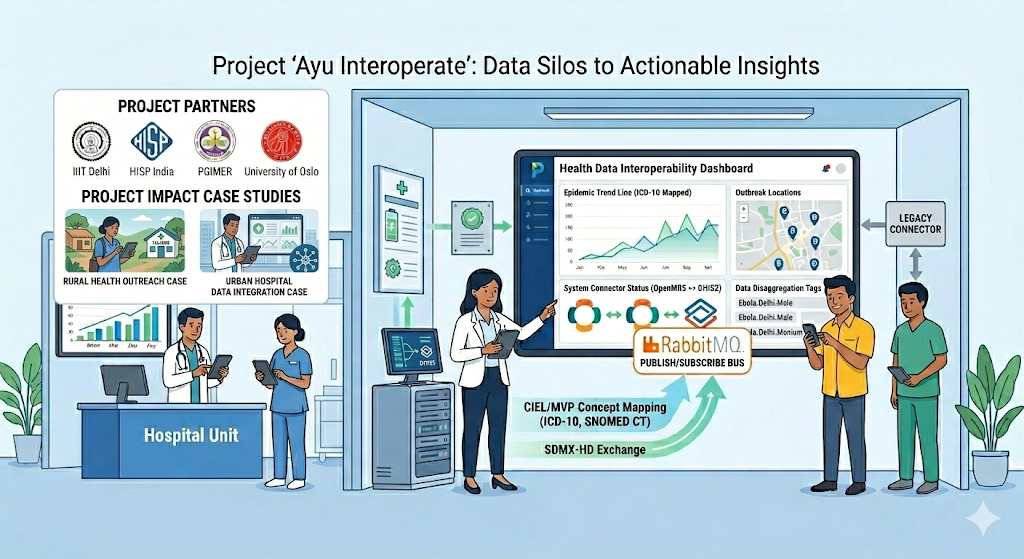
We proposed a Publish/Subscribe (Pub/Sub) architecture moderated by a Web Service to streamline public healthcare data exchange in India. Currently, the delay in transferring field data (from ASHA workers and clinics) to central repositories often spans months, hindering timely policy interventions.
Core Architecture
The system integrates a distributed Pub/Sub layer (using RabbitMQ) with a centralized Web Service.
- Pub/Sub Layer: Provides space, time, and synchronization decoupling, allowing heterogeneous systems to communicate without direct connections. Uses a topic-based paradigm for efficiency.
- Web Service Layer: Acts as a regulatory "gatekeeper" — handles Authentication, Role-Based Access Control (RBAC), and Validation. Ensures data privacy by verifying if a user has the specific permissions required to publish or subscribe to a topic.
Key Features
- Interoperability: Utilizes the CIEL/MVP Concept Dictionary to map local data to international standards (ICD-10 and SNOMED CT), ensuring semantic consistency across fragmented legacy systems
- Granularity and Expressiveness: The Web Service automatically handles "disaggregation tags" (e.g., location, gender). A publisher sends one data packet, and the service parses it into specific sub-topics, allowing subscribers to receive either highly granular data (e.g., Ebola.Delhi.Male) or aggregated totals
- Connector: A lightweight host-side component facilitating easy integration with existing file stores and databases
- Early outbreak detection: By reducing data latency from months to near real-time, the architecture enables early disease outbreak detection and rapid policy response
Live Interoperability Model for Health Information Systems
There exist diverse health information systems today, each addressing a specific need: Hospital Information Systems (HIS) collecting clinical, patient, and administrative data; Health Management and Information Systems (HMIS) collecting health indicators across regions; and Telemedicine systems providing access to remote areas. Integrating information across such diverse systems is technically challenging due to different data models and workflows.
Implementation
We captured the experience of integrating OpenMRS-based hospital information systems and DHIS2-based HMIS deployed across the state of Himachal Pradesh, India.
- OpenMRS: Deployed across 20 hospitals in the state for clinical and patient data
- DHIS2: Used for data collection from multiple reports under the NRHM (National Rural Health Mission) program
- SDMX-HD: Used the WHO-backed interface for statistical data and metadata exchange in healthcare for cross-system communication
- Open source module: Contributed an OpenMRS-DHIS2 interoperability module to enable seamless data flow between the two systems
Hospital Management System Study
As part of this work, we conducted studies of hospital management systems to identify gaps in existing workflows — understanding where data was being lost, duplicated, or delayed in the pipeline from point-of-care to central reporting. These findings informed the design of both the Pub/Sub architecture and the interoperability module.
Technical Stack
- Messaging: RabbitMQ (Pub/Sub layer)
- Standards: ICD-10, SNOMED CT, SDMX-HD, CIEL/MVP Concept Dictionary
- Systems: OpenMRS, DHIS2
- Security: Role-Based Access Control (RBAC), Web Service authentication and validation
- Mobile: Android applications for field data capture by ASHA workers and clinic staff
Collaborators
Partners
Publications
- A Pub/Sub based Architecture to Support Public Healthcare Data Exchange
IEEE COMSNETS 2015
- Interoperability Model for Health Information Systems and Associated Benefits, Challenges and Approach
M.Tech Thesis, IIIT Delhi (2014)